A vibrant field margin bursts with a colourful array of wildflowers, creating a contrast against a cropped field under a clear blue sky. The image captures a serene, sunlit rural landscape, highlighting the beauty and ecological benefit of Agri-Environment Schemes.

Agri-environment schemes: reviewing the evidence

The UK faces many environmental challenges. From declining wildlife populations to concerns about water quality. Therefore, we need to protect and enhance our natural world. Within the UK, farming and forestry account for 80% of the main land management activities. Consequently, farmers and foresters play a key role in helping the natural world regain and retain good health. That’s where agri-environment schemes (AES) come in.

Goats

How goats and satellites are supporting Wales’ rarest mosses

Stanner Rocks National Nature Reserve (NNR) covers just five hectares, yet it is one of the most important botanical sites in Wales. Its steep rocky outcrops support some of the UK’s rarest bryophytes (non-vascular plants, including mosses, liverworts, and hornworts, that lack true roots and reproduce via spores), including rigid apple moss (Bartramia aprica), Dog Screw-Moss (Tortula canescens) and Black Crystalwort (Riccia nigrella). These mosses rely on drought-prone, nutrient-poor soils more typical of Mediterranean landscapes than Welsh habitats. Unfortunately, historic land use change, reduced grazing and increased atmospheric nitrogen have encouraged scrub to spread through Stanner Rocks NNR, altering the light and moisture conditions.

Lush green terraced fields surround a traditional stone village on a steep, rugged slope in Yemen's arid Haraz Mountains.

Uncovering Yemen’s Agricultural Landscape for Sustainable Water Use

Yemen, a nation at the southern tip of the Arabian Peninsula (Figure 1), boasts a remarkably diverse geography – from rugged mountains to arid plains. This varied landscape, coupled with its predominantly arid climate, profoundly shapes agriculture. Farmers have historically adapted, developing three main irrigation methods: ancient highland terraces, natural and artificial channels in wadis and river valleys, and groundwater fed irrigation.

Elevated view overlooking Salt Road Pond and coastline in Anguilla, showing turquoise waters, sandy beach, coastal homes, and surrounding green hills under a bright blue sky.

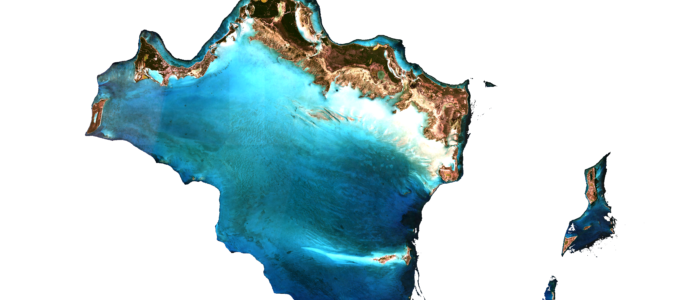
Nature-Based Resilience in Anguilla: Mapping Opportunity for Impact

The UK Overseas Territory of Anguilla faces increasing threats from climate change; rising sea levels, more intense hurricanes, and coastal degradation. These threats are placing homes, livelihoods, and biodiversity at risk. In recent decades, hurricanes, like Irma and Lenny, have caused extensive flooding and considerable financial damage. Unfortunately, traditional mitigations through hard infrastructure are often costly and limited in resilience.

Sunlit deciduous woodland with bluebells and a winding path, overlaid with images of a black grouse, a High Brown Fritillary butterfly, and dry brown bracken.

Bracken mapping for tree planting opportunities

Summary Identified bracken over the North Pennines Combined geospatial data, modelling and analysis Prioritised areas for tree planting opportunities Outcomes Guiding nature recovery activities & landscape-scale initiatives Supporting prioritisation and targeting of tree planting Supporting carbon sequestration via creation of wooded habitats Benefits A replicable and scalable mapping method Reducing the need for labour intensive […]

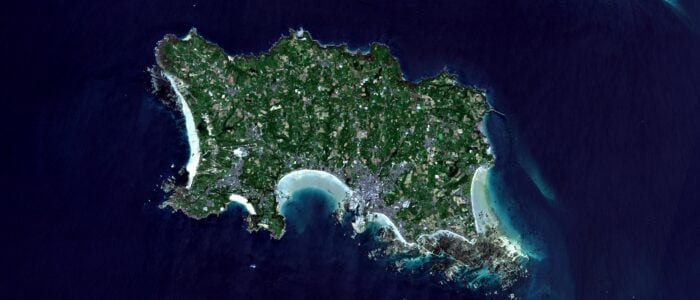
Sentinel-2 satellite image showing the island of Jersey

Supporting the journey to Net Zero in Jersey

Climate change already threatens Jersey; more frequent and intense heatwaves (and therefore demand for water), increased winter rainfall and flooding and a significant threat from sea-level rise to housing, infrastructure, agriculture, and the natural environment. These threats of warmer temperatures and altered rainfall patterns even jeopardise the island’s famed Jersey Royal potatoes!